
The Parliament of India is the supreme legislative body in India. Founded in 1919, the Parliament alone possesses legislative supremacy and thereby ultimate power over all political bodies in India. The Parliament of India comprises the President of India and the two Houses, Lok Sabha (House of the People) and Rajya Sabha (Council of States). The President has the power to summon and prorogue either House of Parliament or to dissolve Lok Sabha.
The parliament is bicameral, with an upper house called as Council of States or Rajya Sabha, and a lower house called as House of People or Lok Sabha. The two Houses meet in separate chambers in the Sansad Bhavan (located on the Sansad Marg), in New Delhi. People commonly refer to the members of either house as Members of Parliament or MPs. Direct elections elect the MPs of Lok Sabha, while the MPs of Rajya Sabha are elected by members of the State Legislative Assemblies and Union territories of Delhi and Pondicherry only, in accordance with proportional voting. The Parliament is composed of 790 MPs, who serve the largest democratic electorate in the world (714 million eligible voters in 2009).
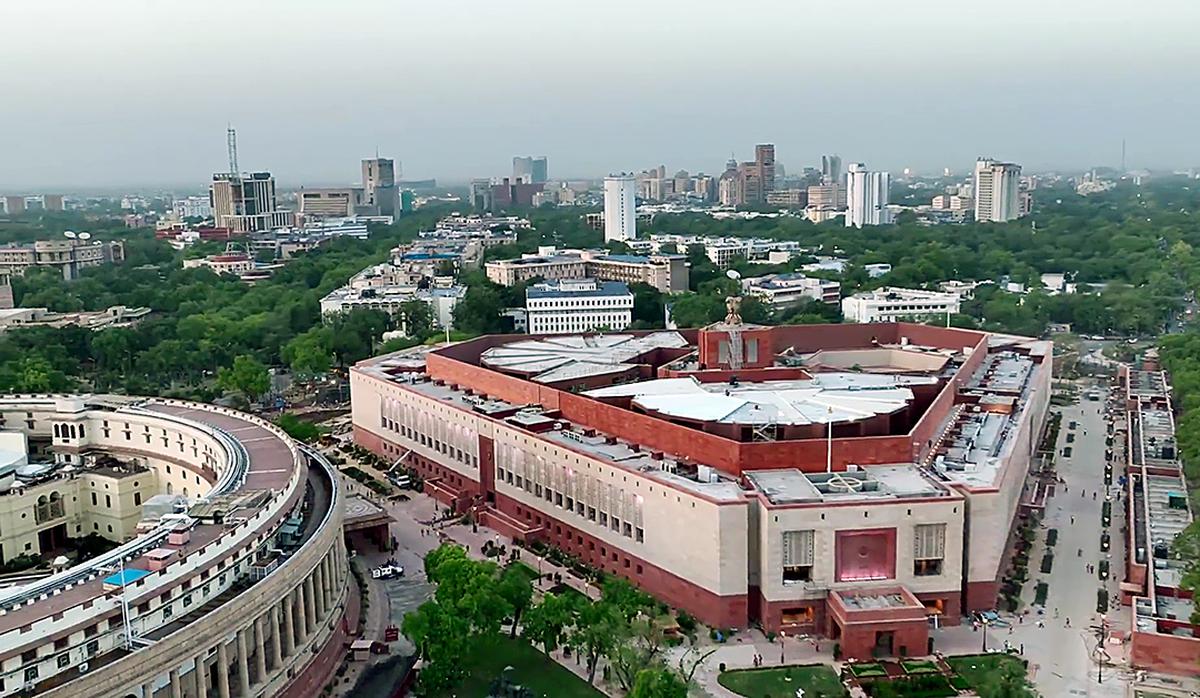
History Of Parliament
During the introductory stage, planners intended for the parliament house, originally known as the ‘Council House,’ to be a part of the Rashtrapati Bhavan. However, in 1919, the Montague-Chelmsford reforms announced its design as the Indian parliament. Architects planned various designs for the building, from a triangular to a Roman colosseum-like structure, which led to its present circular design with a colonnaded verandah, featuring 144 pillars and a diameter of 560 feet. Prince Arthur, Duke of Connaught, the third son of Queen Victoria, laid the foundation stone of the Council House on February 12, 1921. The building in pale and red Dholpur sandstone used the same theme as the neighboring Secretariat Building. Then Governor-General of India, Lord Irwin, inaugurated the nearly six-acre building on January 18, 1927. It is now commonly known as Sansad Bhavan.